How to Label Product Reviews You Haven’t Tested
Label product reviews honestly if you haven't tested the product. Separate catalog facts, manufacturer claims, editorial inference, and firsthand testing.
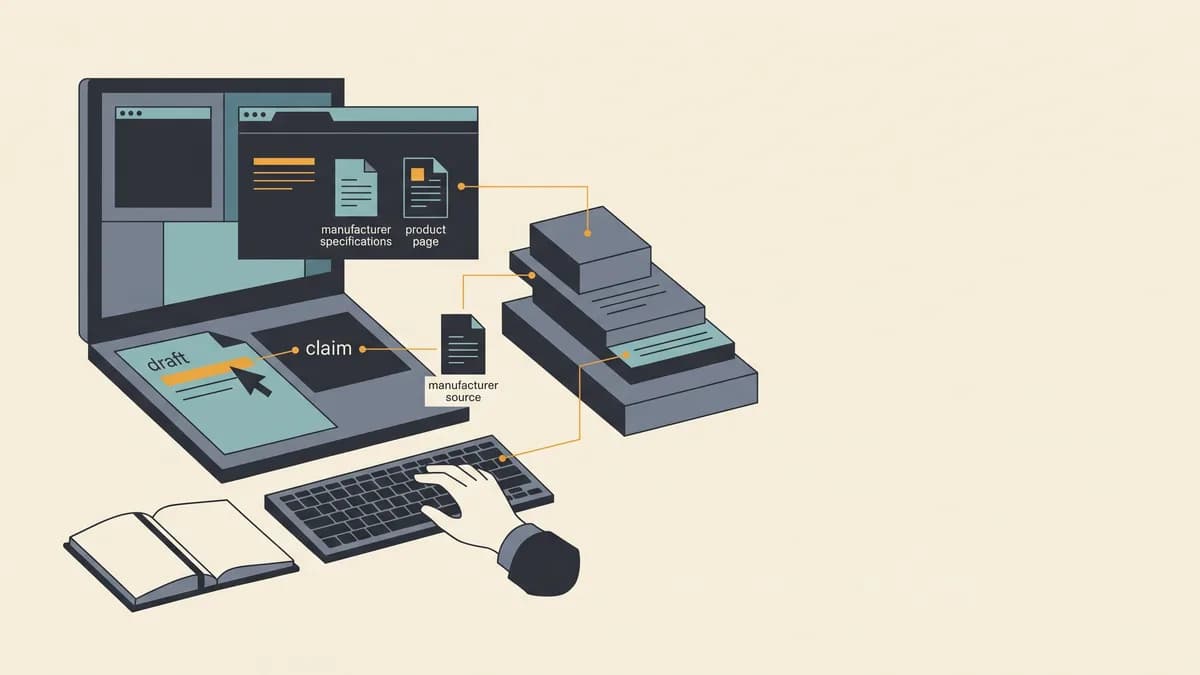
A disclaimer cannot turn a manufacturer's battery claim into your own test result. If nobody on your team has used the product, call the piece a research-based assessment. State that it was not tested before the first recommendation, explain briefly how you researched it, and attribute every claim that could change a purchase in the sentence that makes it.
Labeling is a decision you make claim by claim. A footer disclaimer does not fix copy that sounds hands-on. For each sentence, ask what it lets readers believe you actually know.
Here is the situation this guide works through. A draft lands on your desk. It is confident, fluent, and full of phrases like "punchy sound" and "lasts all weekend." It was assembled entirely from a specification sheet and the manufacturer's product page, and nobody on the team has touched the product. You have to decide which sentences stay, what to call the article, and what readers need to be told.
Call product reviews without testing a research-based assessment
For many affiliate readers, "review" implies use. If your work consisted of reading documentation, comparing specifications, and reasoning about fit, say so. "Research-based assessment" is the label proposed here. It describes the work, and it still promises something useful.
Two kinds of value are easy to blur:
- Assessing documented fit. Does the listed weight, port selection, or water-resistance rating match what a specific reader needs? Documentation can answer this, and a research-based assessment can answer it well.
- Reporting hands-on performance. How does it sound at volume? How long does the battery last on a real afternoon? Is it comfortable to carry? Does it survive a year? Only testing answers these.
Polished prose blurs the line between the two. A sentence like "the bass holds up outdoors" reads as observation even when it was paraphrased from a marketing page. If a reader mistakes fluent writing for lived experience, the editor who approved it is responsible.
The article label tells readers which kind of value they are getting. The claim-level labels below make sure the body keeps that promise. If you also need help arranging the assessment itself, see structuring a useful product review.
Product review evidence labels: four categories for every consequential claim
A consequential claim is any sentence that could change whether a reader buys. Give each one of four evidence labels. These are proposed editorial terms, not a legal standard. Each label carries its own source requirement, wording, and limit.
| Evidence label | Source and check | Publishable wording | Limit |
|---|---|---|---|
| Catalog-listed fact | Catalog field traced back to its origin document; value confirmed against that source | “The manufacturer’s specifications list the weight at X g.” | Being stored in your catalog is not independent verification |
| Manufacturer claim | Manufacturer page or spec sheet, including any stated test conditions | “The manufacturer advertises up to X hours of playback.” | Keeps manufacturer provenance even after it enters your catalog |
| Editorial inference | Your reasoning from labeled facts plus a stated reader need | “On listed weight alone, it fits a lightweight-carry requirement.” | Says nothing about sound, comfort, or durability |
| Firsthand test observation | Documented test by a team member: setup, date, conditions, result | “In our test, playback stopped at X hours.” | Valid only for the unit and conditions tested |
Catalog location and source provenance are separate questions
The table separates two questions: where a value is stored, and where it came from.
Your catalog is where a value lives. Its source document is where the value originated. A battery figure copied from the manufacturer's site into a catalog field is still the manufacturer's figure. The catalog stores it faithfully. It does not verify it.
So a "catalog-listed fact" is not the same as an independently verified fact. It is a value you have traced to a named source and confirmed you transcribed correctly. That is worth something, because it rules out typos and stale data. It is not a measurement.
Keep the origin visible in the wording, and use "listed" or "specified" rather than a bare assertion. "Weighs 480 g" states a fact. "The manufacturer lists it at 480 g" states exactly what you know.
Editorial inference is where your judgment lives
Inference is the label that makes an untested assessment worth reading. You connect a labeled fact to a reader's need and say what follows. That judgment is yours, and you should commit to it. Its limits must stay visible: an inference from listed figures can establish fit on paper and nothing beyond that.
The catalog holds the values. The editor decides which ones matter to this reader. For more on that division of labor, see separating product facts from editorial judgment.
Put the limits where readers make decisions
A test-status note at the bottom of the page reaches only the readers who scroll that far. Put the limits where the decisions happen.
Opening test-status statement
Place this near the top, before the first recommendation or buy button:
We have not tested this speaker. This is a research-based assessment built from the manufacturer's published specifications and product documentation.
Sourcing-method statement
Place this immediately after the test-status statement, or in a short "How we researched this" section near the top:
How we researched this: we compared the manufacturer's specification sheet, product page, and user manual, recorded each value with its source and the date we checked it, and drew conclusions only where the documented specifications answer the question. Sound quality, real-world battery life, comfort, and durability are not assessed here.
Attribution beside performance claims
Article-level statements set expectations. Claim-level attribution keeps them. Every performance figure names its source in the same sentence, such as "advertised," "according to the manufacturer," or "listed at." Readers who jump straight to the battery section from a table of contents still see who is making the claim.
Mixed tested and untested roundups
In comparisons and top-X articles where only some products were tested, label each product at its heading. For example, with eight picks and three tested, each heading reads "Tested" or "Researched, not tested." Within a tested product's section, the same rule applies to individual claims. If you measured runtime but took the waterproof rating from the spec sheet, attribute the rating. A product that carries a "Tested" label is not tested on every axis.
What documentation cannot answer
Name these gaps rather than hedging around them:
- Sound quality, including clarity, bass, and distortion at volume
- Actual battery life at the reader's own volume and usage
- Comfort and real-world portability
- Durability over months of use
- Connection reliability in practice
A reader who sees "not assessed: sound quality" can go find a hands-on review. A reader who sees vague praise cannot tell that they should.
Audit a hypothetical portable-speaker assessment
The following example uses an entirely hypothetical portable speaker and hypothetical source documents. The inputs are:
- A catalog weight of 480 g, entered from the manufacturer's specification sheet
- An advertised runtime of "up to 12 hours" from the manufacturer's product page, under its stated conditions
- A reader preference for a listed weight below 500 g
- A draft sentence with no test behind it: "We got 12 hours in daily use."
The audit follows five steps. Trace each claim's origin, assign an evidence label, compare the figures, rewrite what the evidence supports, and remove what it does not.
| Draft claim | Origin | Label | Outcome |
|---|---|---|---|
| Weighs 480 g | Spec sheet, via catalog | Catalog-listed fact | Keep, attributed |
| 12-hour battery | Product page, "up to" | Manufacturer claim | Keep, attributed |
| Light enough to carry | Editor reasoning | Editorial inference | Keep, qualified |
| "We got 12 hours in daily use." | None | Unsupported firsthand claim | Remove |
The comparison step is simple arithmetic: 500 g − 480 g = 20 g. The listed weight sits 20 g under the reader's preference. That margin exists only between listed figures, so the inference has to say so.
The fourth sentence is the dangerous one. It echoes the advertised figure exactly, which is almost certainly how it got into the draft: a model or a writer restated the manufacturer's number as experience. No test log exists, so the sentence has no source. Softening it to "we found" or "in our experience" would not help. It has to go.
The three statements that survive, rewritten:
- The manufacturer's specifications list the weight at 480 g.
- The manufacturer advertises up to 12 hours of playback under its stated conditions. We have not measured runtime.
- At a listed 480 g, it meets a requirement for a speaker under 500 g. This compares listed figures only. Comfort and real-world portability are not assessed.
Result: three bounded statements, one removed observation, and an article label of research-based assessment, opening with the test-status and sourcing-method statements above. Actual runtime and listening performance stay open questions.
Decision: publish the narrower assessment now if its main job is helping readers shortlist on documented fit, such as weight, ports, and rated specifications. If the article's value depends on whether the speaker actually lasts 12 hours or sounds good, commission a runtime test and a listening session before it carries a recommendation that leans on those qualities.
Affiliate review disclosure is a separate statement
Test status answers "what do you actually know?" An affiliate review disclosure answers "who pays you?" Readers need both answers, and neither statement substitutes for the other.
In the US, the relevant primary guidance is the FTC's Endorsement Guides at 16 CFR Part 255, together with the FTC's FAQ, "The FTC's Endorsement Guides: What People Are Asking."
- §255.1 says endorsements must reflect the endorser's honest opinions, findings, beliefs, or experience. Where an ad represents that the endorser uses the product, the endorser must have been a bona fide user. The FAQ puts it plainly: don't talk about your experience with a product you haven't tried. The deleted speaker sentence is exactly that kind of claim.
- §255.5 says a material connection between endorser and seller that the audience would not expect must be disclosed clearly and conspicuously. The FAQ treats affiliate commissions as a material connection. It says the disclosure should sit close to the recommendation and links, not only in a footer or on a separate disclosures page.
The Guides are the FTC's interpretation of how Section 5 of the FTC Act applies to endorsements. They apply to US advertising, and affiliate content falls within them when a material connection exists. They do not dictate a four-label evidence system. That system is editorial practice layered on top of the legal floor.
An example affiliate disclosure, placed near the top before the first affiliate link and repeated near product buttons:
If you buy through links on this page, we may earn a commission from the retailer.
Keep it in its own sentence or block, separate from the test-status statement. If the two are merged into one paragraph, a reader may assume the commission notice also covers testing, or the reverse.
Carry the policy into drafting and approval
A labeling policy that exists only in a style guide gets ignored under deadline. It needs to shape the draft before it is written, and to block publishing until someone has checked it.
Voice DNA Profiles carry the attribution rules
Voice DNA Profiles works by adding your voice rules, banned phrases, preferred vocabulary, and editorial constraints to the article generation prompt, so they guide the model before the draft exists. For evidence labeling, that means:
- Behavioral rule: every performance figure names its source in the same sentence.
- Negative constraints: in untested assessments, block hands-on phrasing such as "in our testing," "we found," and "after a week with it."
- Custom vocabulary: "research-based assessment," "listed," "advertised," and "not assessed."
- Uncertainty rule: name the unassessed dimension instead of hedging the whole paragraph.
Calibrating these rules takes time. Conflicting constraints can make output sound unnatural or overly aggressive. A "no neutrality" stance rule and an attribution rule can work against each other until you tell the model where each applies: commit firmly on documented fit, and stay bounded on performance.
The claim worksheet stays with the editor
Keep a manual claim worksheet alongside each draft. The editor maintains it as supporting material. It records, for every consequential claim:
- Source URL or document reference
- Access date
- Claim text
- Origin
- Evidence label
- Limitation
- Approved wording
- Editor decision
Human-in-the-Loop Review Gate reserves approval
Human-in-the-Loop Review Gate saves the generated article as a draft and shows it in a review screen. There the editor reads the Markdown/MDX, checks the structure, fixes weak sections, and only then approves it, either as a push to GitHub or as an export to paste into their blog editor. The gate deliberately slows publishing, which is the point when an unsupported firsthand claim is one approval away from going live. Checking evidence labels is the review itself, not an extra step on top of it. For more, read making review the approval decision.
- Record sources in the manual claim worksheet
- Apply attribution rules through Voice DNA Profiles
- Review and edit each consequential claim
- Approve through Human-in-the-Loop Review Gate before publishing delivery
Make the publish-or-research decision
If every item holds, approve the research-based assessment and publish it. If the recommendation depends on runtime, sound, comfort, or durability, keep it out of the article and assign those questions to further research or a hands-on test. A narrower article you can stand behind is better than a broader one built on borrowed experience. To see where Voice DNA Profiles and Human-in-the-Loop Review Gate fit your own review process, explore NichePressa.