How to Build an AI Editorial Voice That Actually Sounds Like You
Learn how to define your stance, vocabulary, and persona so your publishing engine stops writing like a robot and starts mirroring your site’s unique brand.
If you are spending more time editing AI output than you would have spent writing the article yourself, your workflow is broken.
That is the hidden problem with most AI writing tools.
They look fast at first.
You enter a topic, click generate, and get a full article in seconds.
But then the real work begins.
You start fixing the intro.
Then the tone.
Then the weird phrases.
Then the fake confidence.
Then the sections that sound like every other AI article on the internet.
By the end, you are not really using AI to write faster.
You are using AI to create a rough mess that you now have to clean up.
That is not a good publishing system.
That is just outsourced editing pain.
The Problem Is Not Just Bad Writing
Most people think the problem with AI content is that the writing is low quality.
That is partly true.
But the deeper problem is that the AI does not know who it is supposed to sound like.
It does not know your site.
It does not know your audience.
It does not know your opinions.
It does not know which words feel natural for your brand.
It does not know what kind of advice you would actually give.
So it defaults to the safest possible voice.
And the safest possible voice is usually boring.
That is why so much AI content sounds the same.
It is polite.
It is smooth.
It is grammatically fine.
But it has no fingerprint.
Your Site Needs an Editorial Voice
A niche site is not just a place where articles live.
It has a point of view.
Even a simple affiliate site has a voice, whether the owner defines it or not.
For example, a gaming site might sound sharp, opinionated, and practical.
A software review site might sound calm, technical, and direct.
A productivity blog might sound friendly, simple, and action-focused.
A luxury product site might sound polished and selective.
A developer tools site might sound honest, skeptical, and no-nonsense.
All of these voices are different.
But most AI writing tools treat them almost the same.
That is where things go wrong.
Because when every article sounds generic, your site becomes forgettable.
And forgettable sites are hard to trust.
What Editorial Voice Actually Means
Your editorial voice is not just your writing style.
It is the combination of a few important things:
- What your site believes
- Who your site is speaking to
- Which words your site uses often
- Which words your site avoids
- How direct or soft your advice should be
- How much personality the writing should have
- How opinionated the content should feel
- What kind of examples make sense for your niche
In other words, voice is not decoration.
Voice is part of your publishing strategy.
It tells readers, "This site understands me."
That matters.
Especially when the internet is full of articles that feel copied, recycled, or generated from the same invisible template.
Why Prompting Alone Is Not Enough
You can try to fix this with better prompts.
You can write something like:
"Write in a friendly, expert, human tone."
Or:
"Make it sound natural and not AI-generated."
Or:
"Use a casual but professional voice."
The problem is that these instructions are too vague.
Almost every brand wants to sound friendly, expert, human, natural, and useful.
That does not give the AI enough direction.
It is like telling a designer:
"Make it look good."
Good according to who?
Good for what audience?
Good for what kind of brand?
Good compared to what?
The same problem happens with writing.
A better prompt helps, but it does not solve the deeper issue.
The AI needs a reusable voice profile.
Voice Capture Means Defining the Writing System Once
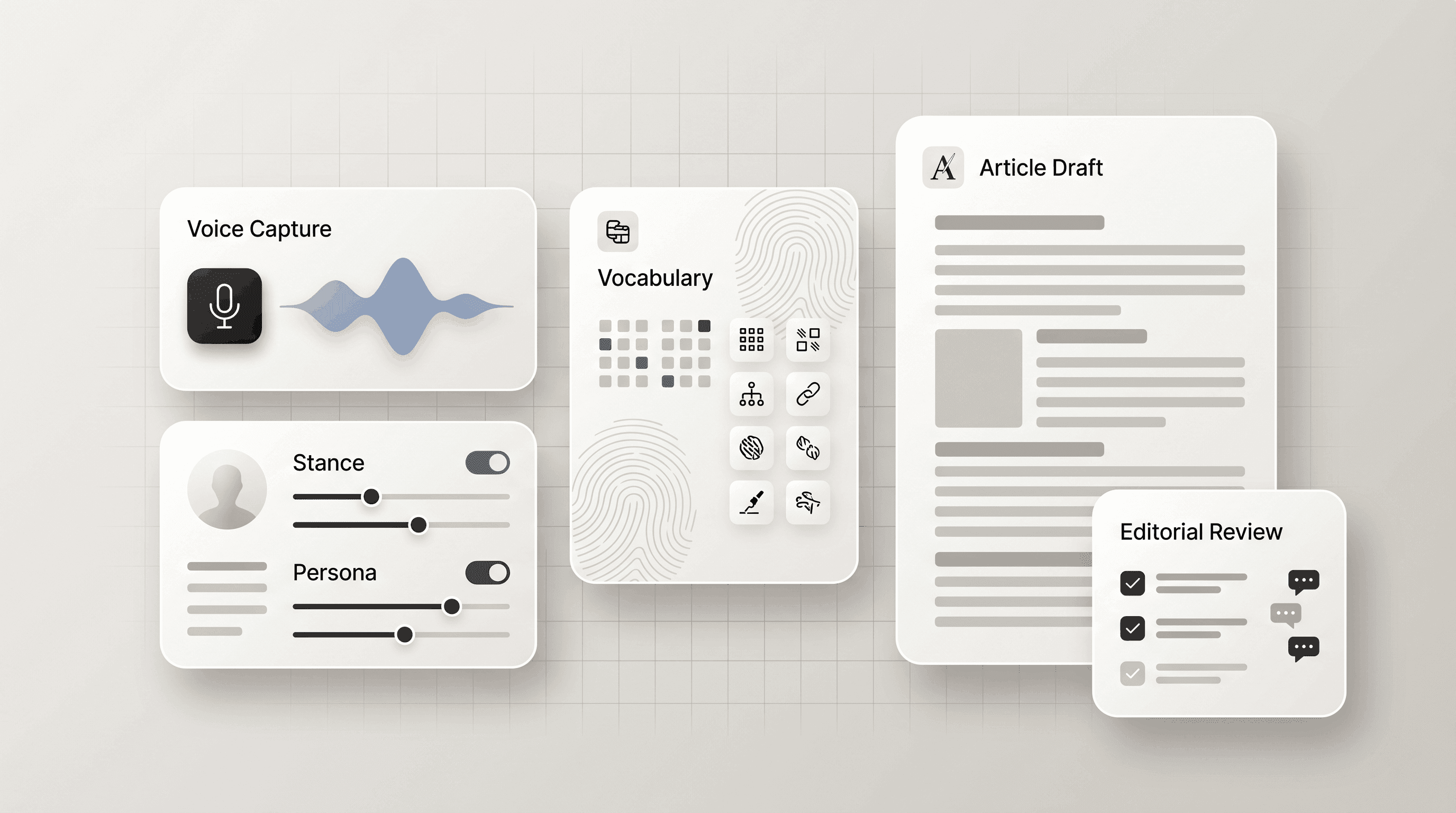
This is why NichePressa includes Voice Capture.
The idea is simple:
Instead of rewriting the same tone instructions every time you generate content, you define your editorial identity once.
Then your publishing engine can reuse that identity across future drafts.
That means your articles start closer to your actual brand voice.
You still review and edit.
But you are not fighting the same robotic tone every single time.
The goal is not to make the AI "sound human" in a generic way.
The goal is to make it sound like your site.
That is a very different target.
The Three Core Parts of Voice Capture
A strong editorial voice usually starts with three layers:
- Stance
- Vocabulary
- Persona
These three pieces give the AI a much clearer picture of how your content should feel.
1. Stance: What Your Site Believes
Your stance is your point of view.
It tells the AI what your site tends to agree with, disagree with, value, or challenge.
For example, a generic AI article about productivity tools might say:
"Choosing the right productivity tool depends on your needs."
That is true, but weak.
A site with a clear stance might say:
"Most productivity tools add more work instead of removing it. The best ones stay out of the way."
That already feels more specific.
The stance gives the article a spine.
Without it, the AI usually writes balanced-but-empty content.
With it, the writing can become sharper and more memorable.
For a niche site, stance can include things like:
- We prefer simple tools over bloated platforms
- We value beginner-friendly games with real depth
- We do not recommend products only because they pay high commissions
- We care about long-term usefulness, not hype
- We explain technical topics without making readers feel stupid
A clear stance helps the AI avoid bland writing.
It also helps your site build trust.
2. Vocabulary: The Words That Feel Like Your Brand
Every site has a vocabulary.
Some sites say "tools."
Others say "stack."
Some say "cheap."
Others say "budget-friendly."
Some say "players."
Others say "builders," "founders," "makers," or "teams."
These choices matter.
They create a familiar rhythm.
They make your content feel consistent.
Vocabulary can include words you want to use often, but it can also include words you want to avoid.
For example, your site might avoid phrases like:
- In today's fast-paced world
- Unlock your potential
- Game-changer
- Seamless experience
- Robust solution
- Cutting-edge technology
These phrases are not always wrong.
But they are everywhere.
And because they are everywhere, they often make content feel cheap.
A good voice profile helps the AI understand which words belong on your site and which ones should stay out.
3. Persona: Who Is Speaking?
Persona is the role your content speaks from.
This does not mean inventing a fake character.
It means deciding how the article should feel to the reader.
Is the writer a friendly guide?
A technical expert?
A skeptical reviewer?
A calm teacher?
A sharp operator?
A niche nerd who has actually used the thing?
Different personas create different articles.
For example, an article about AI writing tools could sound like:
- A marketer selling software
- A publisher sharing lessons from experience
- A technical builder explaining the workflow
- A skeptical editor warning about low-quality content
Those are not the same voice.
The facts might be similar, but the article would feel completely different.
That is why persona matters.
It gives the AI a role to write from.
Good AI Output Starts Before the Article
Many people judge AI writing only after the draft appears.
But the quality of the draft is usually decided before generation starts.
If the AI gets a weak setup, it gives weak output.
If the AI gets a strong voice profile, clear article plan, real catalog data, and proper site context, the output has a much better chance of being useful.
That is the real shift.
Better AI publishing is not just about better models.
It is about better inputs.
Your voice profile is one of those inputs.
It gives the AI a better starting point.
Voice Capture Reduces Editing Pain
The biggest benefit of Voice Capture is not that every article becomes perfect.
It will not.
You should still review AI-generated content.
You should still check claims.
You should still improve weak sections.
You should still add human judgment.
But Voice Capture reduces the annoying first layer of editing.
You spend less time removing generic phrases.
Less time fixing tone.
Less time making the article sound like it belongs on your site.
Less time rewriting intros from scratch.
Instead of editing the AI into your voice every time, your voice becomes part of the system.
That is where the leverage comes from.
Consistency Builds Trust
Readers may not consciously notice your editorial voice.
But they feel it.
When every article has a similar rhythm, opinion, and level of detail, the site feels more stable.
It feels like there is a real editorial brain behind it.
That matters for niche publishing.
A reader might land on one article from search.
Then they click another.
Then another.
If each article feels like it came from a different random AI writer, trust drops.
But if the articles feel connected, the site becomes stronger.
Voice is one of the things that makes that happen.
This Also Helps SEO
Editorial voice is not only about branding.
It also affects SEO indirectly.
Clearer voice usually creates better content.
Better content usually keeps readers more engaged.
A sharper editorial stance can make articles more useful, more memorable, and more link-worthy.
It can also help avoid the common problem of publishing articles that technically target keywords but say nothing new.
Search traffic is not just about matching a query.
It is about satisfying the reader after they arrive.
A strong voice helps your content feel more intentional.
And intentional content has a better chance of standing out.
AI Should Scale Your Taste, Not Replace It
The point of Voice Capture is not to remove the human from the process.
It is the opposite.
Your taste is the valuable part.
Your opinions.
Your standards.
Your way of explaining things.
Your way of deciding what is useful and what is noise.
AI should help scale that.
It should not replace it with generic filler.
That is why NichePressa treats voice as a core part of the publishing workflow.
Not as an afterthought.
Because if your content does not sound like your site, it does not really belong on your site.
The Future of AI Publishing Is Not Robotic
The next wave of AI content will not be won by people who generate the most words.
It will be won by publishers who build better systems.
Systems with catalogs.
Systems with source control.
Systems with human approval.
Systems with clear editorial strategy.
And systems with a voice that readers can recognize.
That is what Voice Capture is built for.
Not to make every article loud.
Not to force personality into every sentence.
But to make your publishing engine stop writing like a generic robot and start writing like it understands the site it is working for.
That is the difference between AI content and AI-assisted publishing.
And for serious niche sites, that difference matters.